


Linguísta e investigador
ROOTS, BASES AND STEMS : A BRIEF PEDAGOGICAL SUMMARY
INTRODUCTION
Morphology is a complex field. It requires time to get familiar with its terminology as well as with all its processes and operations involved. The study of morphology also involves an array of terms that need to be clarified in order to understand how they work when forming and analyzing words, which is the object of study of morphology. So, this brief article is aimed to provide a contrast and a comparison of three essential terms which are essential when analyzing the formation of words in different languages. These terms are root, base and stem.
Root
The term root is one of the terms whose definition is clear and concise. The term root basically means core. In other words, it is the core of the word that has a meaning as the independent word since it has a lexical function on its own (even sometimes it is not a fully understandable word: struct-), and which cannot be further divided into morphemes.[1] It can have morphemes added or not (struct or dog). This means that roots can be free morphemes (not requiring any morphemes because they are pronounceable: dog) or they can be bound morphemes (to add a morpheme to be a pronounceable word: struct- and -duce .[2] In both cases these two morphemes free and bound express the basic meaning of words, which are the core of the word. in this article it has been avoided to use the epression " lecixal meaning" since it can cause confusion. We won't analyse this expression here.
Base
The base terms have been defined from different views and it can sometimes be confusing when analyzing words. In this article base is defined as any form to which affixes of any kind can be added. Sometimes bases do not have a lexical meaning. For example, in the word “refrigerator” the base is “frig” which is the base for “friger” which it does not have a lexical meaning, but that it is also a base for the word “refrigerator”.[3] So, in conclusion all roots are bases, but not all bases are roots (for example, touch is a root and a base for touchable, but touchable is not a root since it possesses a derivational affix).
Stem
Basically, stems are words that can be analyzed in terms of inflectional morphemes. It means that a stem is found when it is removed all the inflectional morphemes. For example, in the word “touchables” the stem would “touchable”.[4] Another example would be the use of the verbs reduce and deduce. Both of them are stems because they can be analyzed in inflectional morphemes when adding a past tense morpheme (past: -d), but also, they cannot be a root because the root -duce requires of two affixes: re – or de- . Stems do not always have a lexical meaning (-duce; - ceive, habl-). [5]In conclusion, some roots are stems and some stems are roots ( dog -, habl- ). However, there are some roots that are not stems ( -duce) and some stems that are not root ( reduce).
In the following page a comparative chart and a formula is provided. This chart aims to provide teachers with a clear view of each definition and avoid a misused of these terms when analyzing words.
COMPARATIVE CHART
COMPARATIVE CHART | |||
TERM | ROOT | BASE | STEM |
BASIC MEANING | ALWAYS | NOT ALWAYS | NOT ALWAYS |
TYPE OF MORPHENES | FREE OR BOUND | DERIVATIONAL | INFLECTIONAL |
A FULLY UNDERSTABLE WORD | NOT ALWAYS | NOT ALWAYS | NOT ALWAYS |
FORMULA
All roots can be bases and stems ( care, kind ) |
Some bases cannot be roots ( careful , carefully ) |
Some roots cannot be stems (- duce; struct -) |
Some stems can be roots ( habl -) |
Some roots can be stems = ( dog-) |
Source : Angel Gomez uriarte
EXERCISES
In this section some exercises are provided to be done in class and explained by the teacher. You can find more exercises on SIL (summer institute of linguistics).[6]
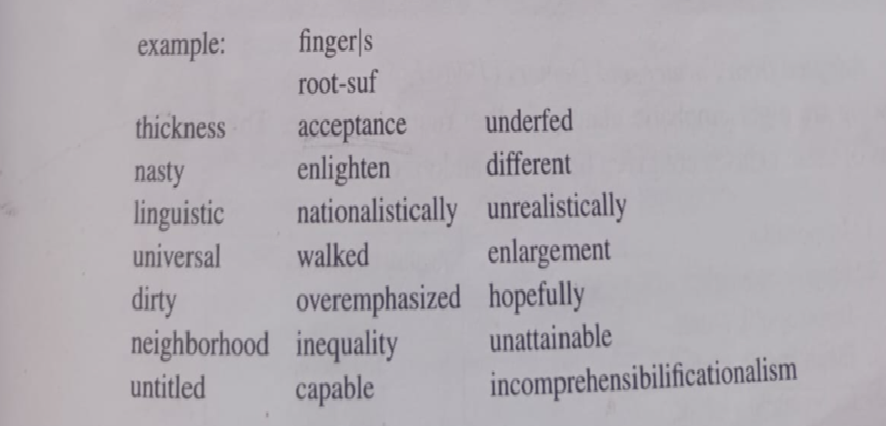
EXERCISE 1 : divide these Seri words into morphemes if were possible . Label the morpheme as a root, base or stems ( it can be more than one use), prefix or suffix. Provide explanations.
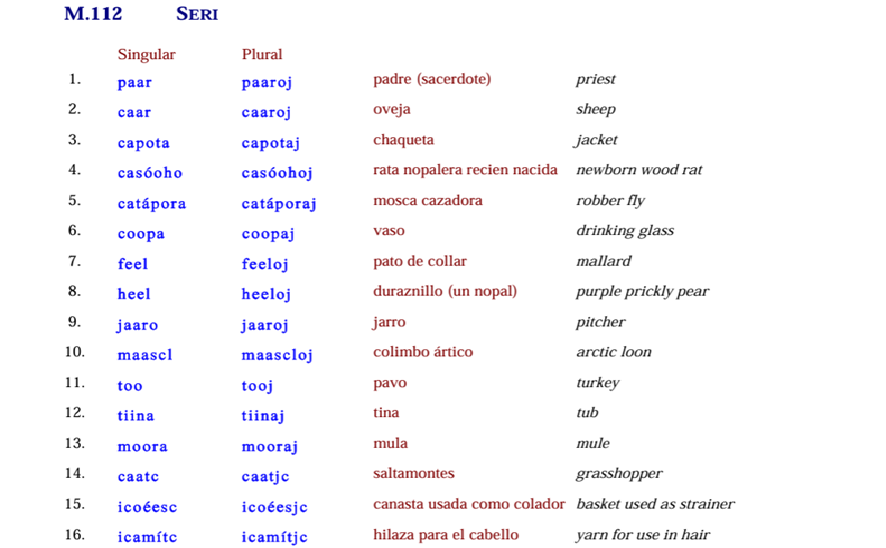
EXERCISE 2 : divide these Seri words into morphemes if were possible . Label the morpheme as a root, base or stems ( it can be more than one use), prefix or suffix.
Questions : what is the morpheme to express the singular? what is the morpheme to express the plural? Analyze each word individually.
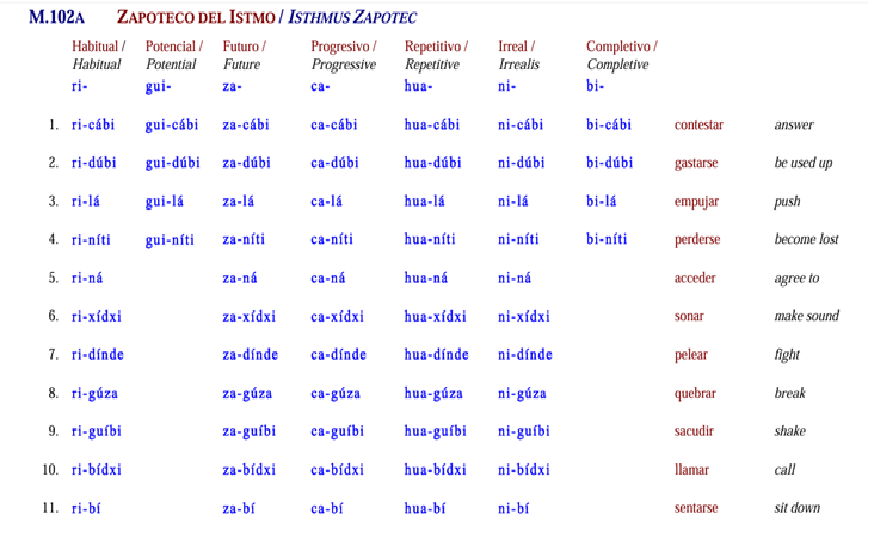
EXERCISE 3 : divide these Seri words into morphemes if were possible . Label the morpheme as a root, base or stems ( it can be more than one use), prefix or suffix.
Questions : what is the morpheme to express the habitual ? what the morpheme is to express the potential? what the morpheme is to express the future ? what the morpheme is to express the progressive? what the morpheme is to express the repetitive ? what the morpheme is to express the irreal? what the morpheme is to express the completive ? Analyze each word individually. Provide explanations
[1] Revise Payne, T. (2006). Introduction to morphology and syntax. In Exploring Language Structure: A Student's Guide (pp. 18) Cambridge: Cambridge University Press.
[2] Revise Payne, T. (2011). Understanding English grammar: a linguistic introduction.(pp.83) Cambridge: Cambridge University Press.
[3] Revise https://www.sfu.ca/person/dearmond/323/323%20/323-Roots-Bases-Stems.fm6.htm
[4] Revise https://patternbasedwriting.com/elementary_writing_success/difference-between-roots-base-word-and-stems/
[5] Revise Payne, T. (1997). Introduction to morphology and syntax. In Exploring Language Structure: A Student's Guide (pp. 24) Describing morphosyntax: A guide for field linguists Cambridge: Cambridge University Press.
[6] Revise https://www.capacitar.sil.org/morfologia/Ejercicios/Ejerciciosmorfosintaxis.htm
Comments